My recent post at NiemanLab:
When MediaNews Group and Journal Register Co. announced a quasi-merger on Wednesday — putting the two under a new common management structure named Digital First, with John Paton serving as CEO of both companies — it was the most dramatic combination of American newspapers companies in years. And it was also a victory for the vision of Dean Singleton, the longtime MediaNews CEO who has been a champion for consolidation in the newspaper industry for decades.
When MediaNews Group and Journal Register Co. announced a quasi-merger on Wednesday — putting the two under a new common management structure named Digital First, with John Paton serving as CEO of both companies — it was the most dramatic combination of American newspapers companies in years. And it was also a victory for the vision of Dean Singleton, the longtime MediaNews CEO who has been a champion for consolidation in the newspaper industry for decades.
Singleton, now MediaNews’ executive chairman, spoke with me Thursday about the move and his belief that more mergers, clusters, and partnerships are essential for the industry’s survival. “Broadcast consolidated, cable consolidated, and newspapers, in order to have the same relevance that cable and broadcast and others have, need to go through consolidation,” he said.
Back in 1996, at a management meeting when I was working at MediaNews, Singleton said that he anticipated one day just three companies would own most of the papers in the country — and he intended MediaNews to be one of them. At the time, the company owned only 13 newspapers and was not among the top 10 in terms of total circulation. Fifteen years later, with paid weekday circulation of about 2.2 million (JRC adds in another 400,000), it ranks second, behind only Gannett’s roughly 5 million.
Having shed most of MediaNews’s debt via a strategic bankruptcy, and having stepped aside from day-to-day management, Singleton is focused on building the next rounds of consolidation. He feels that collectively, the newspaper industry “should have seen the changing media environment sooner and dealt with it sooner,” and that collective strategies are now essential.
For Singleton, Paton seemed like an ideal partner: Their friendship goes back decades, and Singleton actually helped sponsor Paton, who is Canadian, when he needed a green card to work in the United States.
As a reflection of the daunting headwinds facing the newspaper industry, he predicted: “I don’t think there’s any newspaper company in America that won’t have fewer people a year from now than they have today, and fewer still in two to three years.” But he’s not headed for an exit strategy: “I love this business, I’ve been in it since I was 15, and I love it and I care a lot about it.”
Here’s a transcript of our interview. You can also download an MP3 of our conversation. (Due to the interviewer’s klutziness, the first question and a snippet of the first answer were truncated.)
CLICK TO READ THE REST OF THIS POST AT NIEMAN JOURNALISM LAB.
CLICK TO READ THE REST OF THIS POST AT NIEMAN JOURNALISM LAB.


 Not very surprisingly, my former employer,
 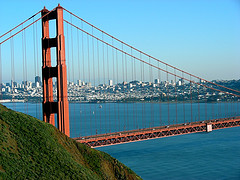 See that bridge? When finished in 1937, it was not an incremental step. It was a leap into the future.