
This is a white paper based on and expanded from my earlier post on the same topic, prepared for the Digital Publishing Alliance meeting at the Reynolds Journalism Institute at the University of Missouri, Columbia, Missouri on March 7-9, 2010
iPad is not a linear, incremental development. It’s not a simple next step after everything that has preceded it (even iPhone); it’s a new direction that will have unpredictable impacts on digital behavior. One potential impact:
iPad will bring a huge increase in mobile shopping (assuming we consider iPad to be a “mobile” device). There was only $396 million in U.S. mobile shopping in 2008; only $1.2 billion in 2009. Before Apple’s introduction of iPad, predictions for mobile shopping were for growth to $119 billion by 2015.
But iPad has the potential to greatly accelerate this trend, because iPad will showcase merchandise and services far better than smartphones, and iPad will claim more leisure time than deskbound computers or smartphones. Consumers with iPads will be connected to the Web in far more places, with far more engagement (relative to smartphones), presenting far more opportunities for direct marketing and sales than any previous interface.
Direct mailers are already nervous, asking “Will the iPad be the nemesis of direct mail?” “Robert Wong, chief executive of Catalogue Central [Australia], which digitises traditional print catalogues for some of the nation's biggest retailers, says the iPad, and an expected flood of copy-cat rivals, will find a place residing on the coffee tables of consumers in a way traditional laptops have failed to do. And he predicts that within five years iPad devices will have proliferated so much that many retailers will eschew letterbox delivery of catalogues for digital.”
Similarly, newspaper preprint revenue is in jeopardy. Preprinted inserts (which amount to half of all retail advertising) are the last newspaper ad category where publishers still have some semblance of monopolistic pricing power, because the supermarkets and big box stores have not found a more efficient way to push their weekly promotions. But the category, already vulnerable because of printing cost, distribution complexity, falling household reach, and even “green” issues, will now be further challenged by mobile digital alternatives.
In considering their strategies for iPad, publishers should assume:
- Mobile will be everywhere. Upward of 70 percent of adults will be connected to the Web on mobile platforms virtually all of their waking hours.
- All forms of media consumption will increasingly shift to mobile devices, especially to iPad and other tablets.
- Marketing budgets will increasingly shift to mobile platforms and out of printed newspapers, magazines and direct mail. (It is hard to imagine many marketers looking for ways to increase their print spending these days, but clearly they're looking for ways to do more online and especially in mobile.)
- Consumers will respond strongly to mobile pitches in the form of ads, video, social recommendations, online catalogues, deals-of-the-day and channels yet to be invented. Spurred also by new options for digital payments, both the ability and the inclination to make mobile purchases goods and services will explode.
- The genie will not go back in the bottle. The Web has atomized content; consumers have learned to surf and explore; new tools will connect them with more content from more sources than ever before. Therefore, selling content in packaged, dated “issues” that emulate the old print product won’t work. Consumers want a hyperpersonalized stream assembled from atomized content.
- We’re only at the beginning of understanding what’s possible on iPad et al. Early concepts like the Sports Illustrated demo are heavily rooted in print, lacking hyperlinks or social functionality. At some point, we should expect a new kind browser created especially for tablets, significantly different from standard browsers, that enables easy touch navigation to let people move around not only from page to page as they have been for 15 years, but more easily from topic to topic, person to person, place to place, idea to idea.
- Embrace the mobile Web and the iPad. As Ken Doctor wrote about Next Issue Media, the tablet publishing consortium, publishers still have a chance to get this one right (“a digital do-over,” Doctor called it), after having misread signals and failed for the last two decades to catch the online waves consumers were riding. The opportunity for publishers here is to lead their audience, rather than belatedly to follow it.
- Reinvent content for the mobile Web and iPad. As Doctor also notes, this is easier for magazines, with their stronger visual orientation and design resources, than it will be for newspapers, which will need to invest in new, innovative design capabilities.
- Challenge journalists to develop new streams of content, in new formats and with new kinds of interactivity and connectivity that will attract new readers and built new relationships of trust with them.
- Work with Apple and other mobile platform entities to enable content and advertising personalization. This means pushing Apple for a more open platform and for access to at least some of their customer data. If publishers are to be players in the mobile marketing game, they must be able to deliver individually targeted marketing messages, and that means having some ability to identify readers and to respond (with their permission) to their profiles and preferences.
- Work with marketers to invent new ways to interact with customers: to facilitate conversations, to blend news, social media and brand messages, to actually sell stuff and facilitate transaction — in short, to leverage those new relationships of trust into brand new streams of revenue.
- Be ready to shift gears often. The job is not just to create a presence on iPad, but to adapt to the new mobile landscape as it develops and changes. Like the saying about the weather in various localities, if you think you have your iPad strategy figured out, wait five minutes.


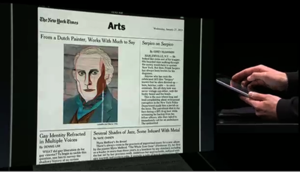 There’s been a lot of hand-wringing in the journosphere about what newspapers ought to be doing vis-a-vis the iPad. If publishers adopt their usual defensive stance and take a slow approach, they’ll miss the iPad boat. Or the iPad rocketship, as the case may be.